
Despite all the advances in medicine, modern diagnostic techniques, and the availability of laboratory tests that allow for molecular-level diagnoses, abdominal pain continues to represent a diagnostic and therapeutic challenge for physicians in general and surgeons in particular. This is because many organs are clustered in close proximity in this area of the body, making it extremely difficult, if not impossible, to determine with certainty whether the pain originates from one organ or another.
This was precisely the situation on May 22nd at La Paz Hospital in Bata when, upon evaluating a 17-year-old female patient who had been presenting with abdominal pain for five days, the clinical findings were inconclusive, and the imaging studies did not allow for a clear determination of whether the pain stemmed from a digestive tract pathology or, conversely, from a gynecological condition.
In these cases, the only way to know the exact cause of the pain is through surgery, by directly inspecting the organs suspected of being the source.
While surgery is a solution, undergoing major abdominal surgery without first identifying the cause of the pain always carries a risk. Patients at La Paz Bata now do not have to face this risk, as the hospital has begun performing minimally invasive laparoscopic surgery to accurately determine the cause without the need for extensive surgery.
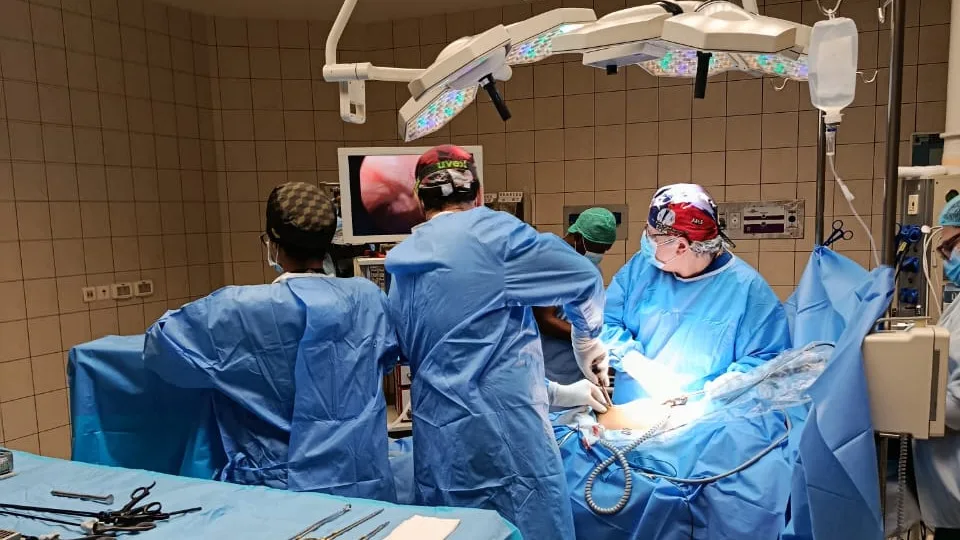
This is precisely what was done in this patient's case. A video camera was inserted through a 1 cm incision in the navel, allowing for the evaluation of the entire abdominal cavity without opening it. This way, not only the areas where the pain was present, but all the organs located in the abdomen were examined.
Once the evaluation was complete, it was determined with certainty (and without large incisions in the abdominal wall) that the pain was caused by a right ovarian cyst.
At this point, two approaches are possible: open surgery to remove the cyst or laparoscopic surgery, which involves using the same camera but with an additional 5 mm incision to insert specialized instruments for draining the cyst.
La Paz Bata Hospital has the resources to treat this condition laparoscopically. The procedure was performed laparoscopically and was completed successfully in less than one hour, with two abdominal wall incisions that required only three sutures to close.
The patient's recovery was excellent, with almost no postoperative pain. Symptoms resolved immediately after leaving the operating room, and she was discharged less than 36 hours after admission.
Without a doubt, having access to laparoscopy made all the difference between a quick, painless recovery and a longer, more painful one, as would have occurred with open surgery.
Thanks to this technology, the patient received the best available treatment for her condition and in less than 1 day she was back with her family and loved ones recovering without major complications.
Medical Team
Anesthesiology
Dr. Trina Torres Salvatierra
Nursing
Ana Castillo, RN
Gabriel Castro, RN
Surgery
Dr. Agustín Bologna R.
Dr. Rafik Ardib